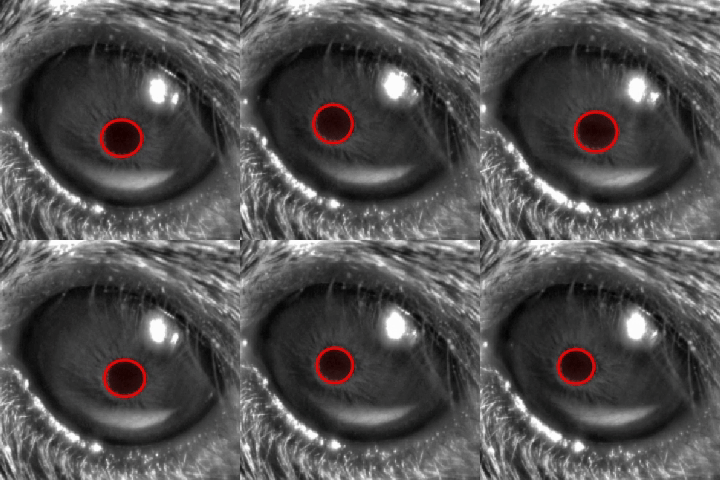
Behavioral Camera

Designing and Coordinating Mouse Behavioral Experiments with Maestro

Behavioral experiments have become an integral part of the methods used in neuroscience to investigate both normal and pathological brain function. A wide range of behavioral protocols has been developed to assess distinct aspects of neural processing, including attention (Wang et al. 2026), working memory (Cleal et al. 2021), and decision-making (International Brain Laboratory et al. 2021).
Animal behavioral experiments commonly rely on three main elements: sensory input, motivation, and response detection. By varying what is presented to the animal, how the animal is motivated to perform a task—through reward, punishment, or avoidance—and how its response is measured, researchers can investigate different aspects of sensory processing, decision-making, and motor execution.

Designing and Coordinating Mouse Behavioral Experiments with Maestro Read More »
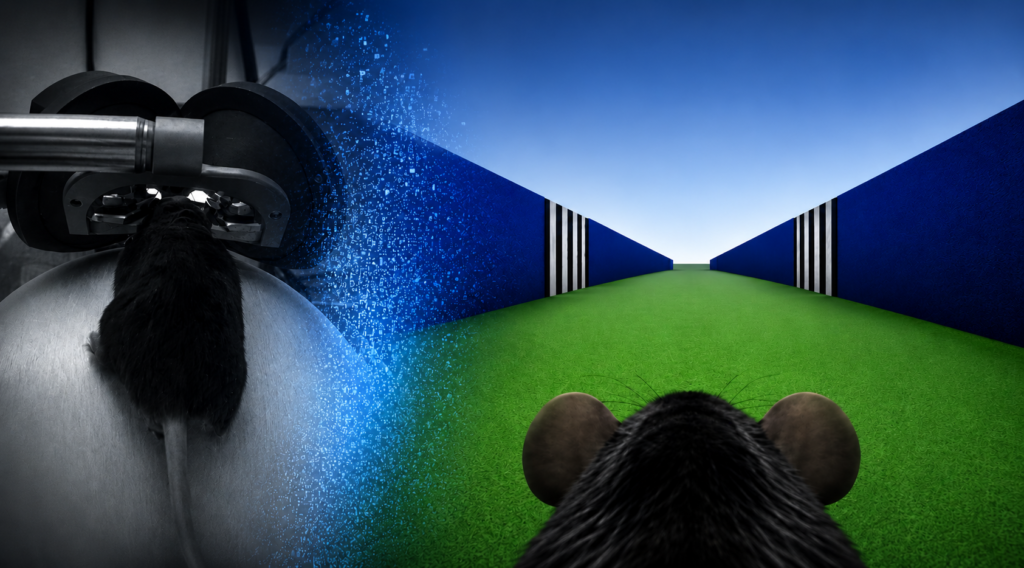
Exploring Learning and Reward Processing with Virtual Reality in Mice

Recording brain activity during unconstrained natural behavior would be ideal to avoid experimental bias. However, this comes with several challenges. Natural behavior is rich and varied, involving multiple sensory stimuli and complex movement patterns. At the same time, this complexity can introduce variability in the data and provides limited control over sensory inputs and behavioral variables. Virtual reality has therefore appeared as an experimental alternative to fully unconstrained behavioral paradigms, offering behaviorally relevant environments while allowing stricter control over experimental variables.

Exploring Learning and Reward Processing with Virtual Reality in Mice Read More »

Eye Tracking: An Invaluable and Inexpensive Tool in Neuroscience

Eye Tracking: An Invaluable and Inexpensive Tool in Neuroscience

Almost all animals with good eyesight exhibit a range of eye movements. These movements allow animals to compensate for shifts in the visual scene and to follow objects that move within that scene. Eye movements have been studied since the early 1900s (Land 2006), and today, eye tracking is a ubiquitous tool used not only in neuroscience but also in other areas such as marketing (Gheorghe, Purcărea, and Gheorghe 2023). It is a common technology applied in virtual and augmented reality devices (Jin et al. 2024).

Eye Tracking: An Invaluable and Inexpensive Tool in Neuroscience Read More »