
Designing and Coordinating Mouse Behavioral Experiments with Maestro
Behavioral experiments have become an integral part of methods used in neuroscience to investigate both normal and pathological brain function. A wide range of behavioral protocols has been developed to assess distinct aspects of neural processing, including attention (Wang et al. 2026), working memory (Cleal et al. 2021), and decision-making (International Brain Laboratory et al. 2021).
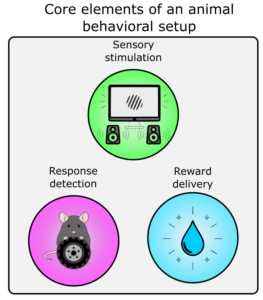
Animal behavioral experiments commonly rely on three main elements: sensory input, response detection and motivation. By varying what is presented to the animal, how its response is measured and how the animal is motivated to perform a task—through reward, punishment, or avoidance—, researchers can investigate different aspects of sensory processing, decision-making, and motor execution.
A typical behavioral setup may include:
Sensory stimulation devices, such as auditory, visual, or tactile stimulators
- Reward-delivery systems, such as water or food-pellet dispensers
- Behavioral response devices, such as levers, decision wheels, or lick detectors
Because a single behavioral experiment may involve several devices, researchers frequently develop custom software to control the equipment and synchronize experimental events. Although these custom solutions may work well for a specific protocol, they often require substantial investment in software development, validation, documentation, and maintenance to ensure reliability and repeatability.
Open-source behavioral platforms, such as the decision-making protocol proposed by the International Brain Laboratory (IBL), have contributed significantly to improving the accessibility and standardization of animal behavioral experiments. However, many available solutions are designed around a particular experimental paradigm or hardware configuration. Adapting them to a different task may require substantial modifications to both the software and hardware, which can discourage researchers from adopting or extending these protocols.
Maestro

Maestro is a behavioral experiment management platform designed to create and execute a wide range of experimental workflows by controlling and synchronizing multiple behavioral devices. Rather than imposing a predefined protocol, Maestro was developed as a flexible environment in which researchers can configure their own experimental sequences and device interactions.
In this blog post, we demonstrate how Maestro can be used to design and execute a complex decision-making task in mice.
Example Case
Overview
This example is based on the IBL’s decision-making task (International Brain Laboratory et al. 2021) and on more recent findings by Gong et al. (2026). The mouse is head-fixed in front of a screen. Following an auditory cue—a 5 kHz pure tone—a Gabor patch appears on either the left or right side of the screen. The mouse must then turn a wheel to move the Gabor patch toward the center of the screen.
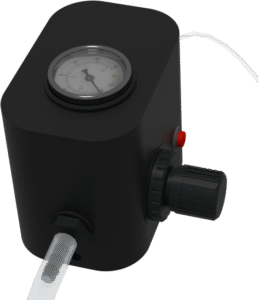
A correct response results in the delivery of a 10% sucrose solution and is classified as a Hit trial. If the mouse turns the wheel in the opposite direction and moves the Gabor patch toward the edge of the screen, the trial is classified as a Miss. If the mouse does not respond within 60 seconds, white noise is played and a brief air puff is directed toward its vibrissae. Before the Gabor patch appears, the mouse must also refrain from moving the wheel during a defined quiet period.
Randomization and response-bias control are important components of this type of behavioral task. The side on which the Gabor patch appears is therefore randomized, or repeated in case of side-bias detection, to reduce the development of a left- or right-side preference. Variability is also introduced into the inter-trial interval to prevent the animal from predicting the timing of the next stimulus.
Reward volume is varied throughout the experiment. For example, on every fifth Hit trial, a larger volume of sucrose solution is delivered (Gong et al. 2026).
The session ends automatically when either 60 minutes have elapsed or the mouse fails to lick the delivered reward within a 90-second timeout period.
Experiment Setup
Maestro is responsible for controlling and synchronizing the devices used throughout the task. It also manages the randomization of the Gabor patch position, inter-trial interval, and reward volume while monitoring the conditions that determine when the experiment should end.
The following devices and software were used in this experiment:
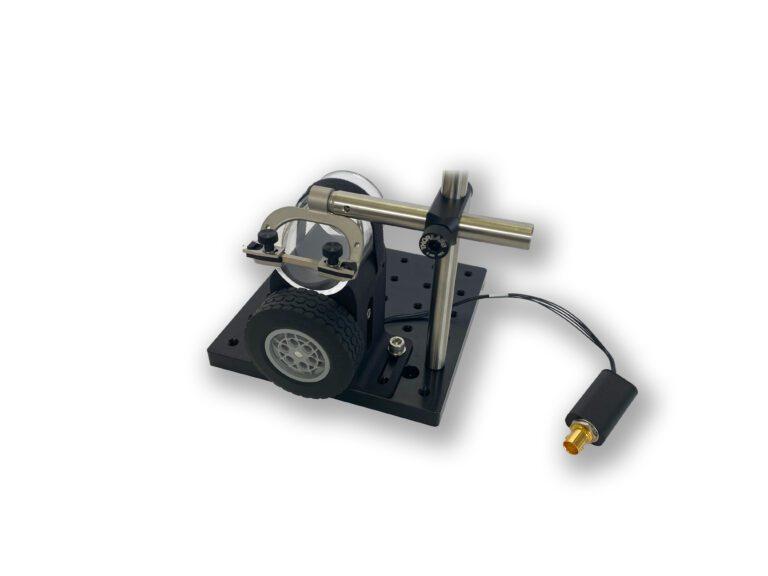
- Behavioral Decision Wheel Setup
- Air-Puff Whisker Stimulator
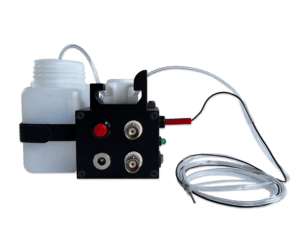
- Water Dispenser with Lickometer
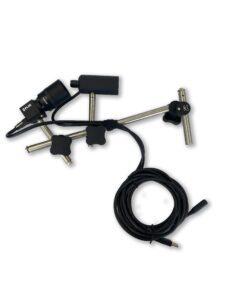
- Primary Behavioral Camera with Infrared Illumination
- Secondary Accessory USB Camera (from Behavioral Task Device)
- Audio Player Control Software
- Visual Stimulation Control Software
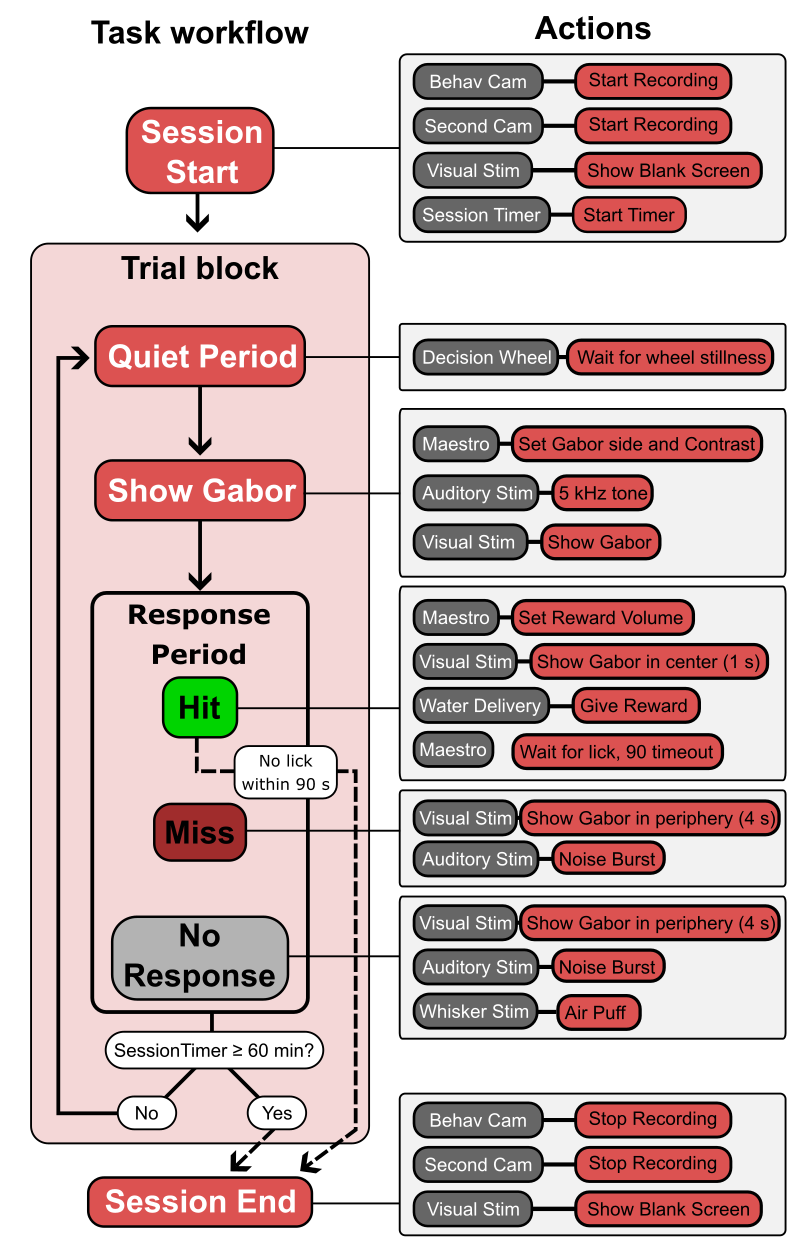
The task workflow is summarized in the figure below. At the beginning of the session, Maestro starts both camera recordings, displays a blank screen, and starts the session timer. The experiment then enters a repeating trial block consisting of a quiet period, during which the wheel must remain still, followed by the presentation of the Gabor patch and classification of the animal’s response as a Hit, Miss, or No Response.
Trials continue until either 60 minutes have elapsed or the mouse fails to lick within 90 seconds after receiving a reward for a correct response.
How Maestro builds and executes the decision-making task
Each connected device provides variables, actions, and events that Maestro can use to control the experiment and respond to changes during the task. Maestro combines these device interfaces with its own variables, equations, rules, timers, and State Machine to construct the complete behavioral workflow.
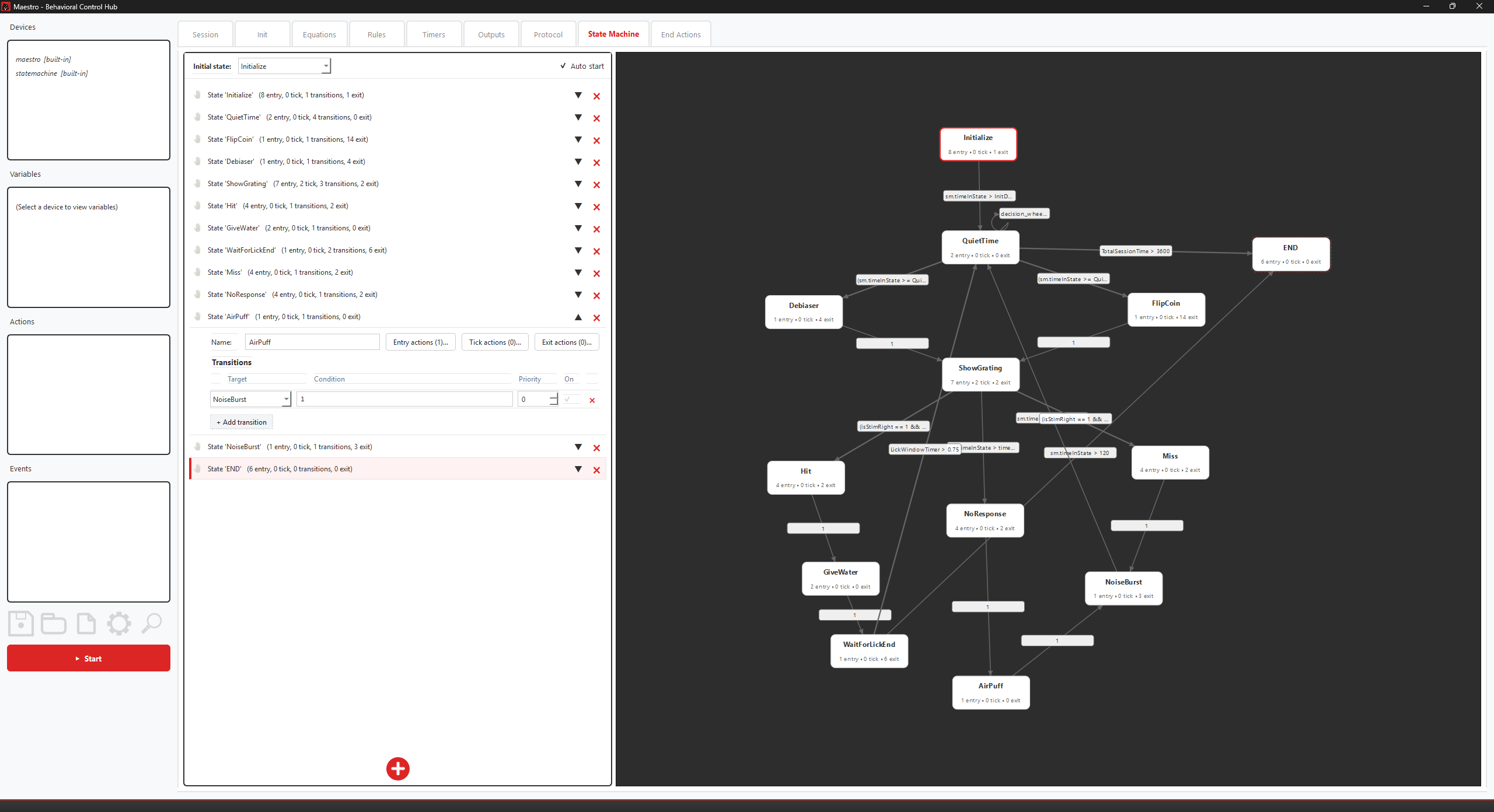
For this experiment, variables are used to track responses and define parameters such as the position and contrast of the Gabor patch. Equations generate randomized trial conditions, while rules determine actions such as the volume of reward delivered. Timers control the overall session duration and the timing of individual events, including stimulus presentation and response windows.
The State Machine brings these elements together by defining the sequence of task phases, the conditions required to move between them, and the actions performed at each step. In this way, the experimental design is translated into an automated workflow that coordinates sensory stimulation, response detection, reward delivery, camera recording, and session control.
Example of a mouse performing the decision-making task created and controlled using Maestro. Inset on bottom left shows the close-up view of the mouse operating the Behavioral Decision Wheel captured with the Behavioral Camera with Infrared Illumination.
Summary and Insights
Reliable behavioral experiments depend not only on appropriate experimental design but also on precise coordination between the devices responsible for stimulation, response detection, reward delivery, and data acquisition. Researchers often develop custom software to achieve this coordination, particularly for highly specialized protocols. However, these solutions may require considerable development, validation, and long-term maintenance.
Maestro provides a common control environment for supported behavioral devices while leaving the experimental protocol in the hands of the researcher. In the example presented here, the task was translated into device configurations, trial phases, randomized parameters, conditional decisions, synchronized actions, and recorded experimental events.
Rather than prescribing a particular behavioral paradigm, Maestro provides the components needed to implement different experimental designs. By managing device communication and task execution within a shared environment, it can make behavioral workflows easier to configure, modify, document, and reproduce.
Products Used

References
Cleal, Madeleine, Barbara D. Fontana, Daniel C. Ranson, et al. 2021. “The Free-Movement Pattern Y-Maze: A Cross-Species Measure of Working Memory and Executive Function.” Behavior Research Methods 53 (2): 536–57. https://doi.org/10.3758/s13428-020-01452-x.
Gong, Sheng, Alyssa Martell, Joshua T. Dudman, and Luke T. Coddington. 2026. “Reward Magnitude Determines Reinforcement Learning Efficiency.” Science 392 (6800): eaeb0813. https://doi.org/10.1126/science.aeb0813.
International Brain Laboratory, Valeria Aguillon-Rodriguez, Dora Angelaki, et al. 2021. “Standardized and Reproducible Measurement of Decision-Making in Mice.” eLife 10 (May): e63711. https://doi.org/10.7554/eLife.63711.
Wang, Lupeng, Christian Quaia, Kerry Elliott, Kara K. Cover, and Richard J. Krauzlis. 2026. “Neuronal Features of Visual Attention in the Mouse Superior Colliculus Depend on Learned Behavioral Relevance.” The Journal of Neuroscience 46 (5): e1187252025. https://doi.org/10.1523/JNEUROSCI.1187-25.2025.
Don’t miss out! Subscribe to our newsletter for the latest blog updates.
We hope you found this post helpful! If you have any questions or need further information, feel free to reach out. We’re here to help!